
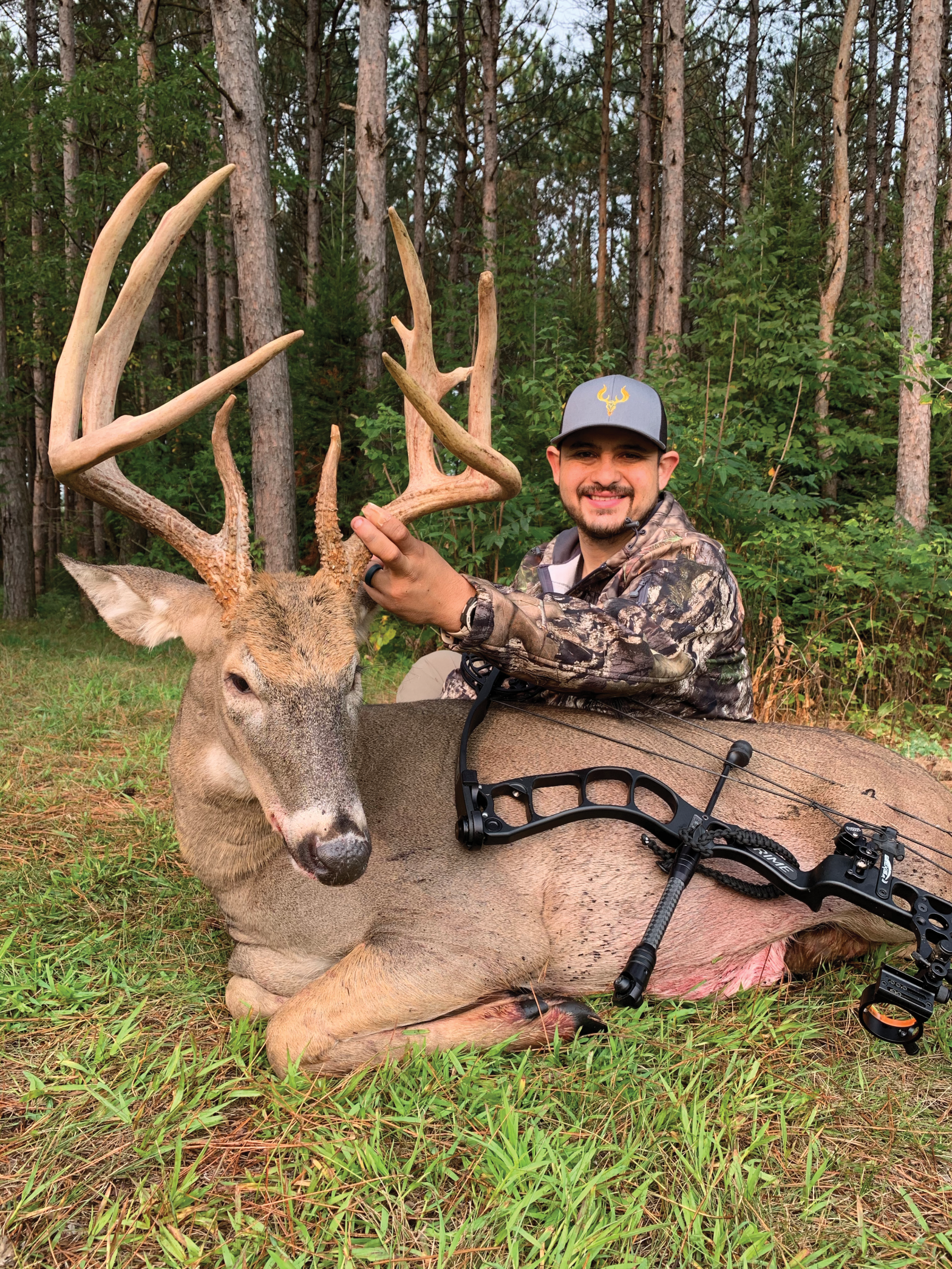
By: David & Sara Gilane
I own a small, 3-acre property in Tigerton, Wisconsin. At one time, it was well-known that Tigerton produced massive bucks thanks to an abundance of farmland and a huge parcel of public land where the hunters worked together to let ‘em grow. Eventually the land was sold off piece-by-piece and the big bucks disappeared with it. But not all of them, and that’s what this story is about.
In the spring of 2020, with the pandemic in full force, there wasn’t much exciting going on, or at least that’s what I thought, until I checked my Browning trail camera in late May. That was the first day I noticed the deer I later named “Jagger.” Jagger was the biggest buck I had ever seen on my property. He was a main-frame 8-pointer with two kickers, for a total of 10 points.
Jagger was a true king of the forest, with his enormous, skyscraper G2s and G3s sitting atop his head and main beams that wrapped so far around the front they nearly touched, just like a crown.
After checking my cameras every few weeks, I plotted his typical travel pattern in my BaseMap app. Right behind my property is a cornfield where I would catch Jagger eating and bedding. After leaving the cornfield, he would travel through the red pine plantation located on my property. Between the cornfield and the pines I placed two treestands, one on each side of Jagger’s trail for differing winds. I knew if I hunted the right wind, either of those stands would be my best bet.
Sept. 12 is my birthday, which happened to fall on the 2020 bow season opener, and the only gift I wanted was Jagger. That day it rained morning to night. I still decided to sit out during the evening because I never enjoy missing opening day. It ended up being a little bittersweet as Jagger stayed hunkered down and lived another day.
Three days later, on Sept. 15, the wind was perfect for the stand I had placed 20 yards from the edge of the cornfield. There was about 20 minutes of daylight left when a doe and her fawn stepped out. I drew my bow, but I noticed them both looking back into the cornfield at something. “Perhaps another deer is in the corn,” I thought. I put down my bow and hoped that something great was soon to come.
The doe and fawn made their way to my pines and wandered out of sight. With the rapidly fading light and no other deer seemingly behind them, I decided it was time to start packing up. I hunched over to place my rangefinder in my backpack when out of the corner of my eye I saw a buck’s rack dip just under the tops of the corn stalks, only 20 yards to my right. Sixty-seconds later a towering buck stepped out of the corn right onto Jagger’s trail. Between being in the last few minutes of shooting light and my accelerated heart rate, I couldn’t tell if it was Jagger, but I didn’t care; I’ll never pass up a good buck. He stopped right at the edge of the field and glanced to his right, providing me a perfect quartering-away shot at 20 yards. I let my arrow fly and the sound of the slap was more satisfying than the inevitable nap after Thanksgiving turkey. The deer ran about 60 yards, and I heard him take his last breath as he crashed behind the pond on the property.

When I walked up to him, I couldn’t believe it — it was Jagger. My emotions took control of me. There he lay after months of meticulous observation, personal restraint and a whole lot of hopes and prayers. The kicker of it all was that the day after I harvested Jagger, the local farmer harvested the corn he was living in. This was very likely the only chance I would ever get, and the stars could not have aligned more perfectly.
Jagger’s main beams measured a whopping 24 inches. He scored 153 6/8 inches. Jagger is the deer of a lifetime. He is a daily reminder that hunting requires a lot of patience, hard work, and in my case, not a lot of land.
 Modern Hunter